
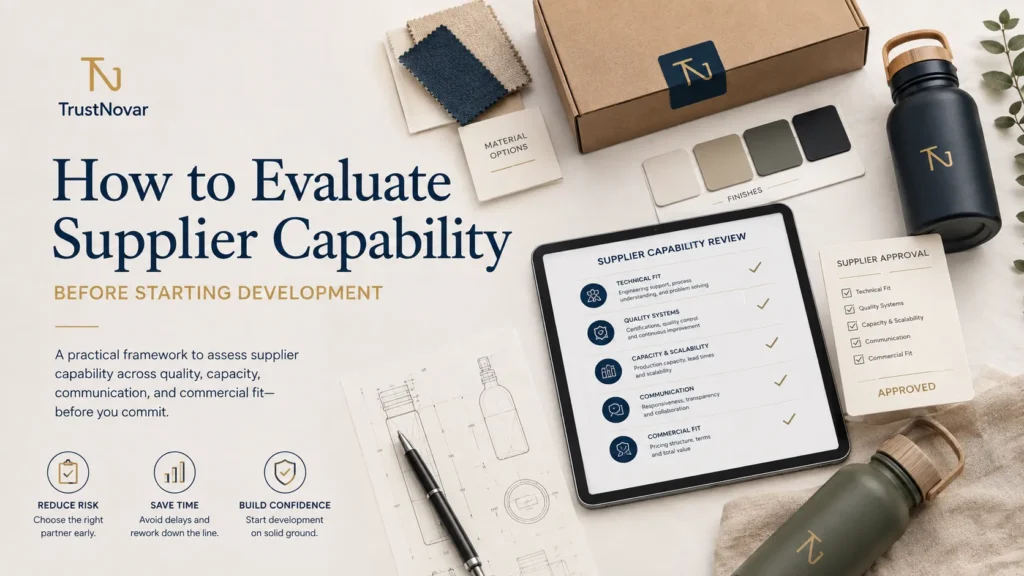
Supplier capability should be evaluated before significant time and resources are committed to product development.
A factory may produce something that looks similar to the intended product, but that does not automatically mean it is the right supplier for the program.
The more customized the project becomes, the more important it is to understand whether the supplier can manage the required materials, construction, quality expectations, production volume, packaging, testing and communication.
A practical supplier evaluation can reduce unnecessary sampling, avoid late-stage factory changes and create a more reliable path from concept to production.
1. Start With the Actual Product Requirements
Supplier evaluation should begin with the product — not with a general factory profile.
Two factories may operate within the same broad category while having very different capabilities.
One may be strong in metal fabrication but weak in decorative finishing.
Another may produce attractive samples but lack experience managing complex packaging or larger retail programs.
Before evaluating suppliers, define the key requirements of the project.
These may include:
- product materials
- construction method
- dimensions
- decorative processes
- expected quality level
- packaging
- testing requirements
- target quantity
- target cost
- required lead time
- destination market
The clearer these requirements are, the easier it becomes to distinguish a genuinely suitable supplier from one that is simply willing to quote.
2. Look Beyond Similar Product Photos
Existing product photos are useful, but they should not be the only evidence of capability.
A supplier may show a product that appears similar while outsourcing important processes or using a very different construction method.
It helps to understand what the factory actually does internally.
Questions may include:
- Which production processes are handled in-house?
- Which processes are subcontracted?
- What materials does the factory regularly purchase?
- What types of tooling can it manage?
- Which finishing processes are familiar?
- What part of the product represents its strongest capability?
This matters because a product is often only as reliable as the least controlled part of its production process.
A factory does not need to manufacture every component internally, but it should understand and control the processes for which it is responsible.
3. Evaluate Technical Fit
Technical capability becomes increasingly important as customization increases.
A supplier should be able to review a product idea and identify potential manufacturing issues before sampling begins.
For example, an experienced supplier may recognize that:
- a wall thickness is too thin
- a particular material will not hold the required finish
- a construction method will create instability
- a proposed decoration is difficult to reproduce consistently
- an assembly method may create excessive labor
- packaging dimensions may need adjustment
This type of feedback is valuable.
A supplier that simply says “yes” to every request may appear cooperative, but early technical questions can actually indicate stronger manufacturing experience.
Good product development depends on identifying problems before they become expensive.
4. Understand Sample-Making Capability
Sampling is one of the best opportunities to evaluate how a supplier works.
The quality of the first sample is important, but the process used to create it is equally revealing.
Consider:
- Did the supplier understand the specification?
- Were questions raised before making the sample?
- Were agreed materials used?
- Were dimensions controlled?
- Were deviations explained?
- Was the sample completed within the expected time?
- How well did the supplier respond to revision comments?
A supplier does not need to produce a perfect first sample.
For customized products, revisions are normal.
What matters is whether the factory understands the reason for the changes and improves the next version accordingly.
5. Review Quality Control Before Production
Quality should not become a discussion only after an order is placed.
Before development goes too far, it is useful to understand how the supplier controls its normal production.
Depending on the product, this may involve:
- incoming material inspection
- in-process checks
- dimensional control
- color or finish standards
- functional testing
- assembly inspection
- final inspection
- packaging checks
The level of documentation required will vary by program.
For many customized products, the important question is whether there is a repeatable method for maintaining the approved standard during production.
An excellent sample has limited value if the factory cannot reproduce it consistently.
6. Check Whether Capacity Matches the Program
Supplier capacity is not simply the maximum number of units a factory claims it can produce.
The more relevant question is whether the supplier can support the required quantity within the actual production window.
Seasonality matters.
A factory may have comfortable capacity during one period and be fully booked during another.
Consider:
- normal monthly capacity
- peak-season loading
- material lead times
- dependence on subcontractors
- number of production lines
- expected production window
- competing seasonal orders
For retail programs with fixed delivery dates, available capacity at the correct time is more important than theoretical annual capacity.
7. Confirm MOQ and Commercial Fit Early
A technically strong factory may still be unsuitable if its commercial structure does not fit the program.
MOQ should therefore be discussed before too much development work is completed.
Other commercial considerations may include:
- tooling costs
- sample charges
- packaging minimums
- material minimums
- payment terms
- small-order surcharges
- export experience
- shipment requirements
The lowest unit price is not always the lowest total program cost.
A factory with an attractive price but an unrealistic MOQ, excessive tooling investment or inflexible packaging requirements may not be appropriate for a new or test program.
8. Evaluate Communication During Development
Communication is part of supplier capability.
Customized development often involves many small decisions.
Measurements change.
Materials are revised.
Artwork is updated.
Packaging comments arrive.
Testing questions appear.
A supplier needs to manage these changes accurately.
Useful signs include:
- questions are specific
- responses address the actual issue
- drawings or photos are used when helpful
- revisions are documented
- deadlines are communicated realistically
- problems are raised rather than hidden
Fast replies alone do not guarantee good communication.
Accuracy and follow-through are more important.
9. Understand the Supplier’s Experience With Your Market
A factory does not need to work with exactly the same retailers, but relevant export and compliance experience can reduce risk.
A supplier familiar with international programs may already understand requirements involving:
- packaging marks
- testing
- labeling
- inspection
- carton specifications
- documentation
- shipment schedules
This can be particularly valuable for products entering markets with customer-specific compliance requirements.
However, customer logos or factory presentations should not be treated as proof by themselves.
The practical question is whether the supplier understands the requirements relevant to the current project.
10. Consider How the Supplier Handles Problems
Almost every development program encounters unexpected issues.
Materials may change.
A sample may fail.
A component may become unavailable.
Production may take longer than expected.
The supplier’s response to these situations can be more important than how it performs when everything goes according to plan.
A useful supplier usually does three things:
identifies the problem, explains the impact and proposes realistic options.
A weaker supplier may delay communication until the issue becomes difficult to recover from.
This is why early development can also serve as a test of the working relationship.
11. Do Not Evaluate Every Supplier the Same Way
Supplier evaluation should match the risk and complexity of the project.
A simple promotional accessory using an established construction may require a relatively straightforward review.
A new seasonal electrical product, multi-component gift set or custom structural item may require much deeper evaluation.
The evaluation effort should increase when the project involves:
- new tooling
- electrical components
- complex construction
- multiple materials
- testing
- high order value
- tight retail windows
- customer-specific packaging
- several subcontracted processes
This keeps supplier qualification practical rather than bureaucratic.
12. Select for the Program, Not Just the Product
A supplier can be capable of producing an individual item but still be a poor fit for the overall program.
The final decision should therefore consider both product capability and program capability.
Ask whether the supplier can support:
- development
- revisions
- documentation
- packaging
- quality consistency
- production timing
- communication
- shipment preparation
This broader view becomes especially important when a retailer expects several related items or repeated seasonal programs.
A supplier that can support continued development may create more long-term value than one selected solely because it offered the lowest initial quotation.
Build Confidence Before Committing
Supplier selection does not require eliminating every possible risk before development begins.
The goal is to identify whether the factory has a reasonable combination of technical capability, quality control, capacity, communication and commercial fit for the intended program.
Early evaluation allows weak matches to be identified before significant sampling, tooling or approval work has been completed.
It also creates clearer expectations between the buyer and supplier from the beginning.
At TrustNovar, supplier evaluation can form part of the product development process — matching product requirements with appropriate manufacturing capabilities, coordinating samples and reviewing commercial, quality and production considerations before moving toward larger commitments.