
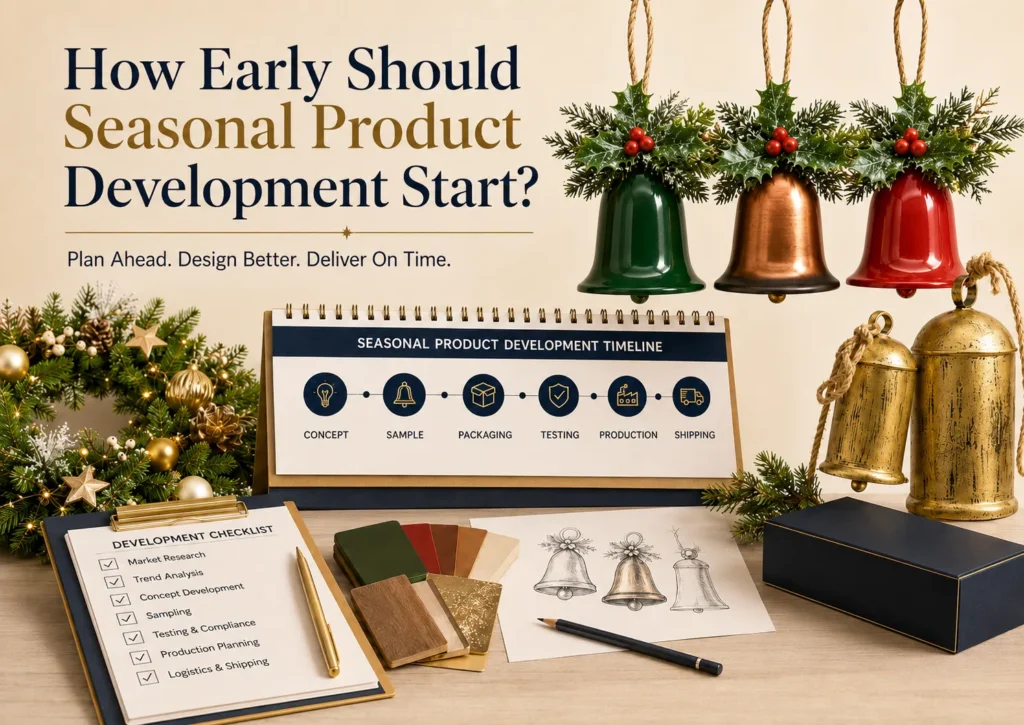
Seasonal product development works best when the timeline is planned backward from the required retail or delivery date.
For retailers and brands, the question is rarely simply whether a product can be manufactured in time. Development may also involve concept review, supplier selection, sampling, revisions, packaging, testing, approvals, production and international shipping.
Starting too late can force decisions that would normally deserve more time.
Starting earlier creates room to evaluate alternatives, solve development issues and protect the final delivery schedule.
There is no single timeline that applies to every seasonal product, but several factors can help determine when development should begin.
1. Start With the Required Retail Date
The most useful starting point is the date the product needs to be available — not the date the purchase order is expected.
Seasonal products often have a narrow selling window. Christmas décor arriving after the main holiday selling period, for example, has a very different commercial impact from an everyday product arriving a few weeks late.
Work backward from the intended in-store, warehouse or promotional launch date.
The schedule may need to include:
- final delivery to the customer
- ocean or air transit
- export and import handling
- production
- final inspection
- packaging preparation
- product and packaging approvals
- testing
- sample revisions
- initial development
Once these stages are visible, the true development window becomes much easier to understand.
2. Different Products Require Different Lead Times
Not every seasonal item needs the same amount of development.
A relatively simple product using existing materials and construction may move quickly.
A custom product involving new tooling, electronics, multiple components or special packaging usually requires more time.
As a general planning reference, projects may fall into broad ranges such as:
| Product Type | Indicative Development Window |
|---|---|
| Simple adaptation of an existing product | 4–6 months |
| Customized product with new materials, decoration or packaging | 6–9 months |
| New construction, tooling or multi-component development | 9–12 months |
| Complex electrical, structural or heavily tested products | 12 months or more |
These are not fixed rules. The appropriate timeline depends on the product, customer requirements, supplier capability and destination market.
The important point is that product complexity should be assessed before committing to the launch schedule.
3. Sampling Usually Takes More Than One Round
One of the most common planning mistakes is assuming that the first sample will become the approved sample.
Sometimes it does.
Often it does not.
Initial samples may reveal issues involving:
- size or proportion
- color
- materials
- construction
- function
- decoration
- finish
- packaging
- target cost
Each revision creates another cycle of communication, production and review.
For seasonal product development, it is useful to build time for at least one possible revision into the schedule rather than assuming immediate approval.
This is especially important when samples must be shipped internationally for customer review.
4. Tooling Can Change the Entire Schedule
Products requiring new molds, dies, frames or other tooling should be identified early.
Tooling affects both development time and cost.
Before tooling begins, the team normally needs reasonable confidence in the product structure because major changes after tooling may create additional expense or delay.
If the product also includes electrical components, moving parts or specially engineered construction, the design may need to be stabilized before other development stages can proceed.
This is why early feasibility review is valuable.
A few days spent confirming the construction direction can prevent weeks of unnecessary rework later.
5. Packaging Should Not Be Left Until the End
Packaging is sometimes treated as the final step, but for seasonal programs it can become part of the critical path.
Retail packaging may require:
- structural development
- artwork
- barcode placement
- warning information
- labeling
- instruction sheets
- customer-specific standards
- carton requirements
- drop or transit considerations
Packaging dimensions can also affect freight efficiency and case pack quantities.
If packaging begins only after the product is completely approved, valuable time may already have been lost.
Where possible, product and packaging development should overlap once the main dimensions and construction are sufficiently stable.
6. Testing and Compliance Need Their Own Time
Some products require third-party testing, documentation or customer-specific compliance review before shipment.
The exact requirements depend on the product category and destination market.
Testing may also reveal something that requires correction.
For example, a construction detail, electrical component, material or label may need to be adjusted before the product can proceed.
Testing should therefore be treated as part of the development schedule — not as a final administrative step immediately before shipment.
The more regulated or technically complex the product, the more important this becomes.
7. Production Capacity Changes During Peak Season
Seasonal products are often developed at the same time many other customers are preparing for the same selling period.
That means factory capacity can become increasingly limited as the season approaches.
Materials may take longer to obtain.
Production lines may be fully booked.
Packaging suppliers may also become busy.
A production lead time that looks comfortable several months earlier can become much harder to secure closer to peak season.
Starting development earlier provides more flexibility when selecting factories, confirming materials and reserving production capacity.
8. Shipping Time Is More Than Transit Time
International shipping plans should include more than the estimated number of days on the water.
Additional time may be needed for:
- booking space
- cargo consolidation
- export procedures
- port handling
- customs clearance
- domestic delivery
- unexpected transportation delays
For seasonal products, a schedule with no buffer can quickly become risky.
It is usually better to protect the delivery date with some contingency rather than planning every stage against the latest theoretically possible deadline.
9. Use Milestones Instead of One Final Deadline
A seasonal project is easier to manage when it has several internal milestones.
For example:
Concept Direction → First Sample → Revised Sample → Final Approval → Packaging Approval → Testing → Production → Inspection → Shipment
Each milestone creates a point where the team can review whether the project is still on schedule.
If one stage begins to slip, decisions can be made earlier rather than discovering the problem shortly before shipment.
This also makes communication between buyers, suppliers and development teams much clearer.
10. Earlier Does Not Mean Developing Everything at Once
Starting early does not mean committing immediately to every product idea.
Early planning can begin with a smaller number of activities:
- reviewing concepts
- identifying potential suppliers
- estimating target costs
- confirming construction feasibility
- testing materials
- reviewing packaging directions
- identifying compliance requirements
Ideas can then be filtered before significant sampling or tooling costs are incurred.
This allows retailers and brands to begin early while still keeping the development process disciplined.
Build the Timeline Backward
The right time to begin seasonal product development depends on how much needs to happen between the initial idea and the required retail date.
Simple adaptations may move relatively quickly.
Products involving new tooling, packaging, testing, multiple suppliers or complex construction should begin much earlier.
The safest approach is to build the schedule backward from the required delivery date, allow realistic time for approvals and revisions, and identify the stages that could become critical if delayed.
At TrustNovar, seasonal planning connects product development with supplier coordination, sampling, packaging, testing, production and shipment requirements so that potential timing risks can be identified earlier in the process.