
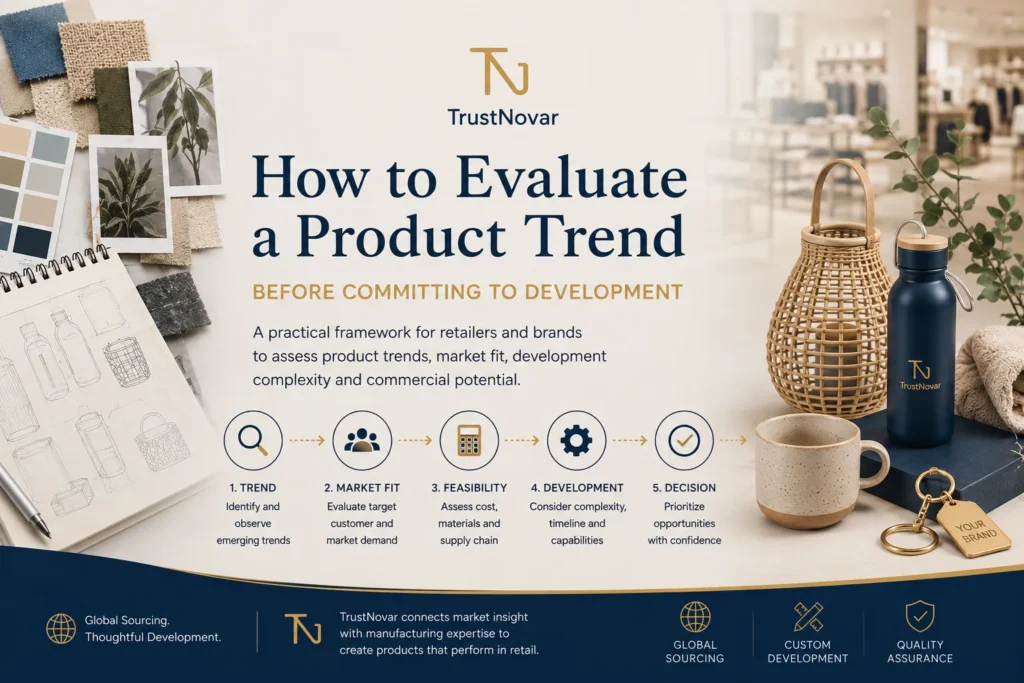
Before committing resources, retailers and brands need to evaluate a product trend from several practical angles. New product ideas often begin with something simple: a product seen at retail, a material gaining attention, a new decorative direction, or a concept appearing across several markets.
But seeing a trend is not the same as identifying a viable product opportunity.
For retailers and brands, the more important question is whether the idea can be translated into a product that fits the target customer, price point, timing and supply chain.
Before committing to development, it helps to evaluate a trend from several practical angles.
Seven Practical Checks for Evaluating a Product Trend
1. Look for Repetition, Not Just Novelty
A single interesting product does not necessarily indicate a broader trend.
More meaningful signals usually appear repeatedly across different places: retail stores, trade shows, online marketplaces, product launches, packaging directions or adjacent categories.
The objective is not to copy what is already selling. It is to understand which elements are appearing consistently.
These may include:
- materials or finishes
- color combinations
- shapes and decorative details
- packaging styles
- functionality
- seasonal themes
- gifting formats
Repeated signals are usually more useful than isolated examples.
2. Consider Whether the Trend Fits Your Customer
A trend can be commercially successful and still be wrong for a particular retail program.
Before developing a product, consider how closely the idea matches the intended customer, selling environment and price architecture.
A decorative accessory suited to a specialty retailer may need a very different material, size or finish when developed for a promotional program.
Likewise, a product that works as a premium gift may require significant simplification to reach a mass-retail price point.
The strongest product opportunities are usually not the most fashionable ideas. They are the ideas that can be adapted naturally to the customer and program.
3. Separate the Core Idea From the Execution
When reviewing a trend, identify what is actually creating the appeal.
Is it the shape?
The material?
A finish?
The way several products are coordinated?
The packaging?
The seasonal story?
This distinction matters because the original execution may not be practical for your program.
For example, a product may look attractive because of a complicated handcrafted detail. If that detail creates excessive labor cost or production inconsistency, the better development direction may be to preserve the visual effect while changing the construction.
This is where product development becomes more important than simple sourcing.
4. Check Development Complexity Early
Some ideas look straightforward until development begins.
Before investing heavily in samples, review factors such as:
- new tooling requirements
- material availability
- assembly complexity
- decoration methods
- electrical components
- packaging structure
- testing requirements
- minimum order quantities
- production lead time
These factors can quickly change the commercial viability of a product.
An attractive concept may still be worth developing, but understanding the complexity early allows the project team to make better decisions about design, timing and target cost.
5. Test the Idea Against a Realistic Target Price
Trend evaluation should always include cost.
The question is not simply:
Can this product be made?
A more useful question is:
Can this product be made at the required quality and presentation within a commercially workable price range?
If the first quotation is above target, that does not always mean the idea should be abandoned.
Possible adjustments may include:
- simplifying construction
- changing a material
- reducing unnecessary components
- adjusting size
- modifying decoration
- redesigning packaging
- separating essential features from optional features
The objective is to protect the character of the product while improving commercial feasibility.
6. Consider Timing Before Starting Development
Timing is particularly important for seasonal and promotional products.
A promising idea may not be suitable for the current buying window if development requires extensive sampling, tooling, testing or packaging approval.
In those cases, the same concept may be more appropriate for the following season rather than forcing development into an unrealistic schedule.
Evaluating timing early helps prevent rushed approvals and avoidable production risk.
7. Decide What Is Worth Testing
Not every idea needs to become a full development project.
Sometimes the best next step is simply to test one element:
- a material sample
- a finish
- a prototype
- a construction method
- a packaging concept
- a target-cost version
Small development steps can provide enough information to decide whether the larger opportunity is worth pursuing.
This approach is especially useful when the commercial potential is promising but still uncertain.
From Trend Observation to Product Opportunity
Successful product development rarely comes from following every trend.
It comes from identifying the right signals, understanding why they matter, and deciding how they can be translated into products that fit a specific customer and program.
For retailers and brands managing multiple categories, a disciplined evaluation process helps reduce unnecessary development while giving stronger ideas the attention they deserve.
At TrustNovar, product sourcing and development often begin with this type of practical evaluation — connecting market observations with materials, suppliers, production methods, packaging and commercial requirements.
A structured approach to evaluate a product trend can help teams focus development resources on stronger opportunities.