
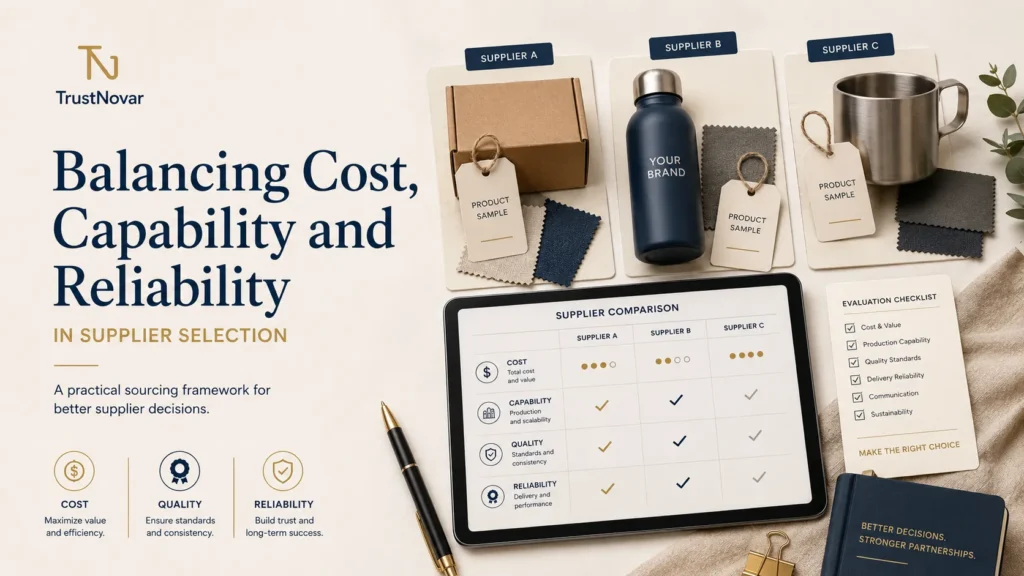
Supplier selection is rarely as simple as choosing the lowest quotation.
For customized product programs, the best supplier is usually the one that offers the right overall balance of cost, technical capability, quality consistency, reliability and communication.
A low price may look attractive at the beginning of development, but the total cost of a supplier relationship can change significantly if samples require repeated revisions, production is inconsistent or delivery schedules become difficult to manage.
At the same time, the most technically capable factory is not automatically the right choice if its MOQ, pricing or commercial structure does not fit the program.
A practical supplier selection process therefore looks at the complete project rather than one number on a quotation.
1. Start With the Requirements That Cannot Be Compromised
Before comparing suppliers, identify the requirements that are essential to the program.
These may include:
- target product quality
- construction method
- required materials
- compliance or testing requirements
- delivery date
- order quantity
- packaging standards
- critical dimensions
- functional performance
- customer-specific requirements
These are different from preferences.
For example, a slightly lower unit cost may be desirable, but meeting a mandatory testing requirement is essential.
Separating requirements from preferences makes supplier comparison more objective.
It also prevents teams from selecting a low quotation that cannot realistically support the final product specification.
2. Compare Total Program Cost, Not Only Unit Price
Unit price is important, but it represents only one part of the commercial picture.
Other costs may include:
- tooling
- sample charges
- packaging
- testing
- inspection
- minimum order requirements
- small-order surcharges
- freight efficiency
- rework
- replacement goods
- delays
A supplier that is several percent cheaper at the quotation stage may become more expensive if packaging is inefficient or defect rates are higher.
Similarly, a slightly higher-priced supplier may provide stronger engineering support, more reliable production or better material control.
The correct comparison is therefore not:
Which factory has the lowest price?
It is:
Which supplier gives the program the strongest overall commercial result?
3. Understand What Is Behind a Low Price
A low quotation is not automatically a warning sign.
Some suppliers are genuinely more efficient.
They may have better material purchasing, more suitable equipment or a production process that matches the product particularly well.
However, it is useful to understand why the price differs.
Possible reasons include:
- different materials
- thinner construction
- simplified finishing
- lower packaging specifications
- larger MOQ assumptions
- fewer inspection steps
- outsourced processes
- different component quality
- more efficient production
When quotations vary significantly, comparing specifications line by line can reveal whether suppliers are actually quoting the same product.
Price comparisons are meaningful only when the underlying requirements are comparable.
4. Give Technical Capability Appropriate Weight
For highly customized products, supplier capability can have a major effect on development efficiency.
A technically strong supplier may be able to:
- identify structural problems early
- suggest alternative materials
- simplify construction
- improve assembly
- reduce unnecessary tooling
- recommend more stable finishing methods
- resolve production issues before they become delays
This support can save both time and money.
In contrast, a supplier with limited technical understanding may be able to reproduce a straightforward product but struggle when revisions or new engineering decisions are required.
The more customized the product, the more weight technical capability should carry in supplier selection.
5. Reliability Becomes More Important When the Retail Window Is Fixed
For seasonal or promotional programs, timing can have greater commercial importance than a small difference in unit cost.
A product that arrives after its selling window may lose much of its value.
Supplier reliability therefore includes:
- realistic lead times
- material planning
- production capacity
- communication about delays
- consistency between sample and production
- shipment preparation
- ability to maintain agreed milestones
A reliable supplier does not necessarily promise the shortest lead time.
Often, a supplier that gives a realistic schedule and communicates problems early is safer than one that agrees immediately to every requested date.
6. Evaluate Quality Consistency, Not Only Sample Quality
A strong sample is necessary, but supplier selection should also consider whether the approved standard can be maintained through production.
Key questions may include:
- Are materials controlled consistently?
- Are colors and finishes repeatable?
- Are dimensions checked during production?
- Are critical functions tested?
- Is final inspection systematic?
- Are packaging standards monitored?
The cost of poor consistency can be significant.
It may create:
- rework
- rejected goods
- shipment delays
- replacement costs
- customer claims
- damaged supplier relationships
For that reason, quality consistency should be considered part of commercial value rather than treated as a separate issue.
7. Consider MOQ and Flexibility
The strongest factory in technical terms may not be commercially suitable for a smaller or developing program.
MOQ can affect:
- initial investment
- inventory risk
- trial-order flexibility
- assortment breadth
- ability to test new products
For new products, a supplier willing to support a realistic trial quantity may create more value than one offering a lower price only at very high volumes.
However, extremely low quantities can also create inefficiencies for factories.
The objective is to find a production level that works reasonably for both sides.
Supplier selection should therefore consider not only the lowest achievable MOQ but whether the supplier’s normal production model matches the expected program.
8. Communication Has a Real Cost
Communication problems are difficult to show on a quotation sheet, but they affect the cost of development.
Examples include:
- unclear answers
- missed revisions
- outdated drawings
- inconsistent specifications
- late notification of problems
- repeated questions that were already resolved
Each issue consumes time.
For a simple product, communication risk may be manageable.
For a multi-component or frequently revised project, it can become a significant operational burden.
Strong communication does not mean sending more emails.
It means accurately understanding requirements, confirming changes and maintaining clear records.
9. Use Different Suppliers for Different Strengths When Necessary
Not every program should be forced into one factory.
A supplier may be excellent in one category and average in another.
For example:
- one factory may be strong in metalwork
- another in resin
- another in packaging
- another in woven materials
- another in electronics
For multi-item programs, selecting suppliers according to their strongest capability can produce better results than asking one factory to manage unfamiliar processes.
However, using more suppliers increases coordination requirements.
The benefits of specialization therefore need to be balanced against:
- communication
- sample coordination
- color matching
- packaging consistency
- shipment consolidation
- quality control
This is where sourcing strategy becomes a program decision rather than simply a factory decision.
10. Do Not Change Suppliers Too Quickly Over Small Price Differences
A lower quotation from a new factory can be tempting, especially after a product has already been developed.
But changing suppliers can introduce new costs.
The new factory may need to:
- remake samples
- recreate tooling
- identify materials
- reproduce colors
- understand packaging
- repeat testing
- learn customer requirements
If the price difference is small, these transition costs may outweigh the expected savings.
This does not mean suppliers should never be changed.
It means switching should be based on meaningful commercial or operational benefits rather than price alone.
11. At the Same Time, Do Not Stay With a Supplier Only Because of History
Long relationships can create valuable trust and efficiency.
An established supplier may already understand:
- quality expectations
- packaging formats
- communication style
- shipping procedures
- customer standards
That familiarity has real value.
But supplier performance should still be reviewed objectively.
If a factory’s pricing becomes consistently uncompetitive, quality declines or capacity no longer fits the program, history alone should not prevent alternatives from being considered.
Strong sourcing relationships combine continuity with ongoing evaluation.
12. Use a Simple Supplier Comparison Framework
Supplier decisions become easier when important criteria are evaluated together.
A simple framework may look like this:
| Criteria | Supplier A | Supplier B | Supplier C |
|---|---|---|---|
| Cost | Strong | Very Strong | Moderate |
| Technical capability | Very Strong | Moderate | Strong |
| Quality consistency | Strong | Moderate | Very Strong |
| Capacity | Strong | Strong | Moderate |
| MOQ flexibility | Moderate | Very Strong | Strong |
| Communication | Very Strong | Moderate | Strong |
| Delivery reliability | Strong | Moderate | Very Strong |
The purpose is not to create a mathematically perfect score.
It is to make trade-offs visible.
A supplier that is cheapest may clearly show weaker performance in areas that are more important to the project.
Choose the Best Fit for the Program
Effective supplier selection is about balance.
Price matters.
Capability matters.
Quality and reliability matter.
MOQ, communication and timing matter as well.
The relative importance of each factor changes depending on the project.
A simple repeat order may place greater emphasis on price and consistency.
A new custom product may require stronger technical support.
A seasonal program may prioritize timing and reliability.
A small launch may need flexibility more than maximum production efficiency.
The strongest supplier is therefore not always the largest factory, the cheapest factory or the factory with the best sample.
It is the supplier whose capabilities and commercial structure best match the requirements of the program.
At TrustNovar, sourcing decisions can combine supplier capability assessment, product requirements, quotation comparison, sampling, quality considerations and production planning to help identify manufacturing partners that provide the right overall fit for each project.