
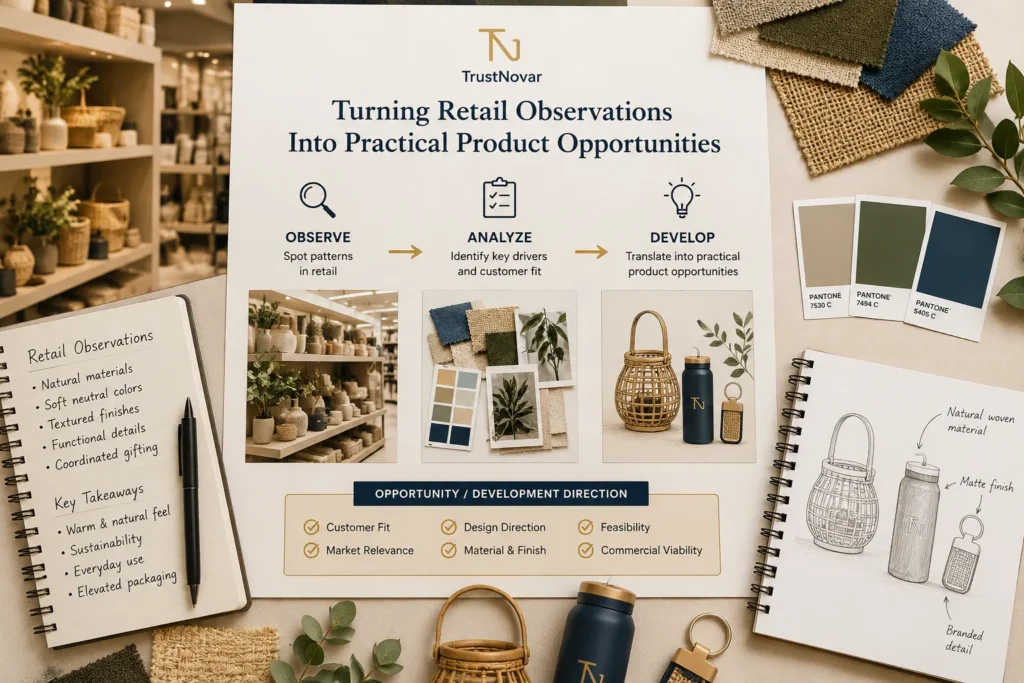
Retail observations can provide valuable clues about where product opportunities may be developing.
A new material appearing across several categories, a recurring packaging direction, a shift in color, or a familiar product presented in a different way can all signal changes in customer preferences.
But observing something interesting in the market is only the beginning.
The real value comes from understanding which details matter, why they are gaining attention, and whether they can be translated into products that make sense for a specific customer, price point and retail program.
1. Observe Patterns Rather Than Individual Products
A single attractive product may be inspiring, but it does not necessarily represent a broader opportunity.
More useful signals often appear repeatedly across different stores, categories, brands or markets.
For example, several unrelated products may begin using similar natural materials, softer color palettes or simplified packaging. The products themselves may be completely different, but the repeated visual or functional direction can reveal a wider shift.
The objective is not to copy what is already on the shelf.
It is to identify patterns that may influence future product development.
Useful observations may involve materials, finishes, shapes, colors, packaging, functionality, gifting formats or seasonal presentation.
2. Ask What Is Driving the Appeal
Once a pattern has been identified, the next question is why customers may be responding to it.
Sometimes the appeal comes from appearance.
In other cases, it may come from practicality, convenience, sustainability, perceived value or the way a product fits into a broader lifestyle.
A decorative accessory, for example, may gain attention because of a particular finish rather than the product itself.
A gift set may appear premium not because the individual items are expensive, but because the packaging and presentation create a coordinated experience.
Understanding what creates the appeal makes it easier to develop something relevant without simply reproducing the original product.
3. Separate Inspiration From Replication
Retail research should support original development rather than direct copying.
The strongest product opportunities often come from taking one useful observation and applying it in a new way.
A material used successfully in home décor may inspire an accessory.
A packaging structure used in beauty products may suggest a presentation solution for gifting.
A color direction seen in fashion may translate into seasonal home products.
This type of cross-category thinking allows development teams to respond to market signals while still creating products that are appropriate for their own customers and programs.
It also creates more room for differentiation.
4. Test the Observation Against the Target Customer
Not every retail trend belongs in every market.
Before turning an observation into a development project, it is important to consider the intended customer.
Questions may include:
Does the idea fit the retailer’s existing assortment?
Does it match the expected retail price?
Is the style appropriate for the target demographic?
Would the concept work in the intended selling season?
Does it offer something new without feeling disconnected from the rest of the program?
An idea can be attractive in isolation but still be commercially unsuitable for a particular account.
Strong product development starts with the customer, not the trend.
5. Consider How the Idea Could Be Adapted
The original retail example may not be practical in its existing form.
Materials may be too expensive.
Construction may require excessive labor.
Packaging may be unsuitable for shipping.
A decorative technique may not be consistent enough for larger production quantities.
Instead of rejecting the concept immediately, it can be useful to ask which parts of the idea are essential and which parts can change.
A premium material may be replaced with a more practical alternative.
A complicated shape may be simplified.
A decorative detail may be recreated through a different process.
A large package may be redesigned to reduce freight volume.
The goal is to preserve the reason the idea is appealing while adapting the execution to commercial realities.
6. Evaluate Feasibility Before Investing Too Heavily
Retail observations can generate many possible ideas, but not every idea deserves full development.
Before moving into detailed sampling, it helps to review basic feasibility.
Important considerations include expected cost, tooling requirements, supplier capability, minimum order quantity, testing needs, packaging complexity and production lead time.
This early review can quickly reveal whether an idea is realistic.
It can also identify where adjustments are needed before time and resources are committed.
A simple feasibility discussion often prevents unnecessary sampling and helps the strongest concepts move forward more efficiently.
7. Look for Opportunities Across More Than One Product
Sometimes the most valuable observation is not a single product idea but a broader direction that can connect several products.
A finish may work across keychains, accessories and packaging.
A seasonal theme may be applied to décor, gifts and promotional products.
A coordinated material story may support several items within one retail collection.
This is particularly useful when retailers are building assortments rather than purchasing isolated products.
Thinking in collections can create stronger visual consistency while also allowing development costs, materials and supplier capabilities to be coordinated more effectively.
8. Keep Commercial Potential in the Discussion
Creative inspiration is important, but product opportunities ultimately need to work commercially.
Before moving forward, consider how the proposed product could perform within the intended program.
That includes more than unit cost.
It can involve perceived value, differentiation, packaging, retail presentation, order quantity, logistics and repeat potential.
An idea with strong visual appeal but poor production efficiency may require further refinement.
A simpler idea with clear customer relevance, reliable manufacturing and a realistic price point may represent the stronger opportunity.
From Observation to Development
Retail research is most useful when it leads to better questions rather than immediate answers.
What patterns are appearing?
Why are customers responding to them?
Which elements could be adapted?
Does the idea fit the target customer?
Can it be developed within realistic cost, timing and production requirements?
Turning retail observations into practical product opportunities requires both creativity and commercial discipline.
At TrustNovar, market observations can serve as a starting point for product development — connecting emerging ideas with materials, supplier capabilities, target pricing, packaging and production requirements to determine which concepts are worth developing further.